
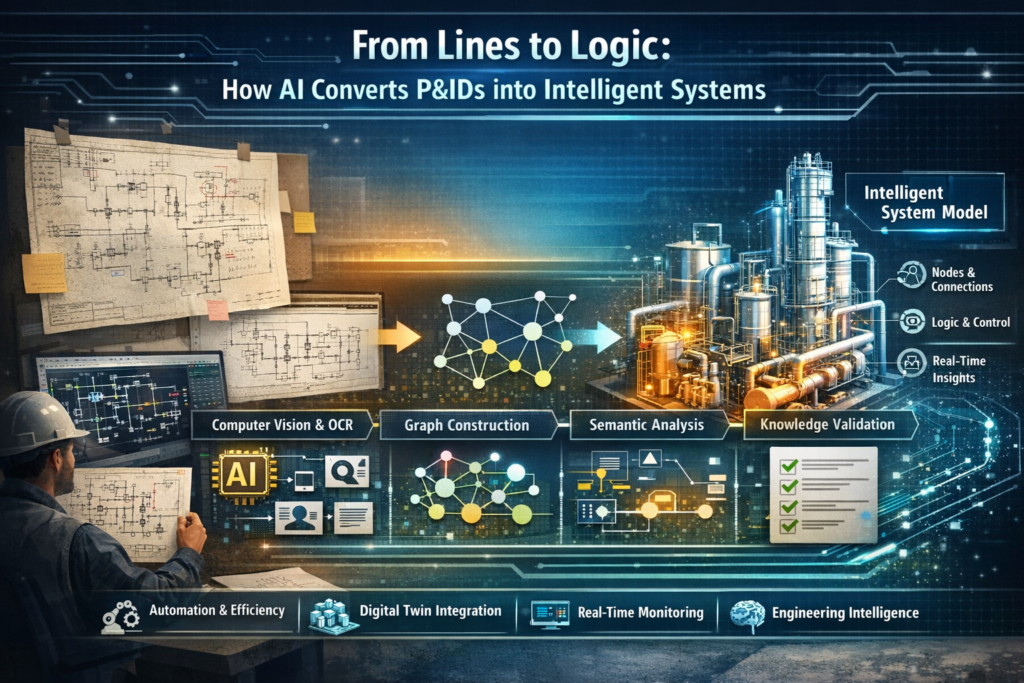
Engineering drawings, especially Piping and Instrumentation Diagrams (P&IDs), are the backbone of industrial operations. They define how systems function, how components interact, and how processes flow across a plant. Yet despite their importance, most P&IDs today remain static documents, interpreted manually by engineers and rarely leveraged as structured, intelligent data.
This is where Artificial Intelligence (AI) is redefining how engineering drawings are understood and utilized.
Why P&IDs Are More Than Just Drawings
Most existing solutions rely on basic OCR or rule-based extraction. While these methods can identify text or simple shapes, they fail to understand relationships and context.
As a result:
- Connections between components are often misinterpreted
- Engineering rules are not enforced
- Manual validation becomes necessary
- Automation remains limited and error-prone
The assumption that extracting symbols equals understanding a system is fundamentally flawed. True intelligence requires understanding how everything is connected and why.
How AI Converts P&IDs into Intelligent Systems
AI-powered systems approach P&IDs not as drawings, but as structured representations of real-world processes.
Here’s how the transformation happens:
Data Ingestion:
P&IDs are ingested from multiple formats such as PDFs, images, or CAD files. Preprocessing ensures that drawings are clean, segmented, and ready for analysis.
Computer Vision & OCR:
AI models detect equipment, pipelines, valves, and instrumentation symbols. OCR extracts tags, labels, and annotations embedded in the drawing.
Graph Construction:
Instead of storing elements as isolated objects, AI converts the entire diagram into a graph:
- Nodes represent equipment and instruments
- Edges represent connections and flow paths
This step is critical, it transforms a visual drawing into a machine-readable system.
Knowledge Base Validation:
Extracted data is validated against engineering standards and domain rules (such as ISO and ISA conventions). Any inconsistencies are flagged or corrected.
Semantic Understanding:
The system begins to interpret intent:
- Identifying process loops
- Understanding control relationships
- Recognizing dependencies between components
At this stage, the P&ID is no longer a drawing, it becomes an intelligent model of the plant.
Key Benefits of AI-Driven P&ID Understanding
Transforming P&IDs into intelligent systems unlocks significant operational value:
Automation at Scale:
Reduce manual engineering effort in interpreting and updating drawings.
Improved Accuracy:
Minimize human error by validating designs against standards and rules.
Faster Decision-Making:
Enable real-time insights into system behavior and dependencies.
Digital Twin Enablement:
Convert legacy drawings into structured inputs for digital twin models.
Knowledge Retention:
Preserve engineering expertise embedded in drawings, even as teams change.
Beyond Drawings: A Shift Toward Engineering Intelligence
The real shift is not just technological, it’s conceptual.
Instead of treating P&IDs as documentation, AI enables organizations to treat them as:
- Data sources
- Decision engines
- Foundations for automation
This reframes engineering drawings from passive assets into active components of industrial intelligence systems.
How SMHcoders Can Help
At SMHcoders, we specialize in building AI-driven systems that transform engineering data into actionable intelligence. Our approach combines computer vision, machine learning, and deep domain expertise in industrial engineering.
Here’s how we support organizations in unlocking the full value of their P&IDs:
AI-Based Drawing Understanding Systems:
Custom solutions that convert P&IDs into structured, machine-readable formats.
Graph-Based Process Modeling:
Transform diagrams into connected systems for simulation, validation, and optimization.
Standards & Rule Integration:
Embed engineering standards and client-specific rules directly into AI workflows.
Legacy Data Digitization:
Convert existing PDF and CAD drawings into intelligent digital assets.
End-to-End Automation Pipelines:
From data ingestion to validation, visualization, and system integration.
By bridging the gap between engineering drawings and intelligent systems, SMHcoders enables organizations to move from static documentation to dynamic, data-driven operations.
