
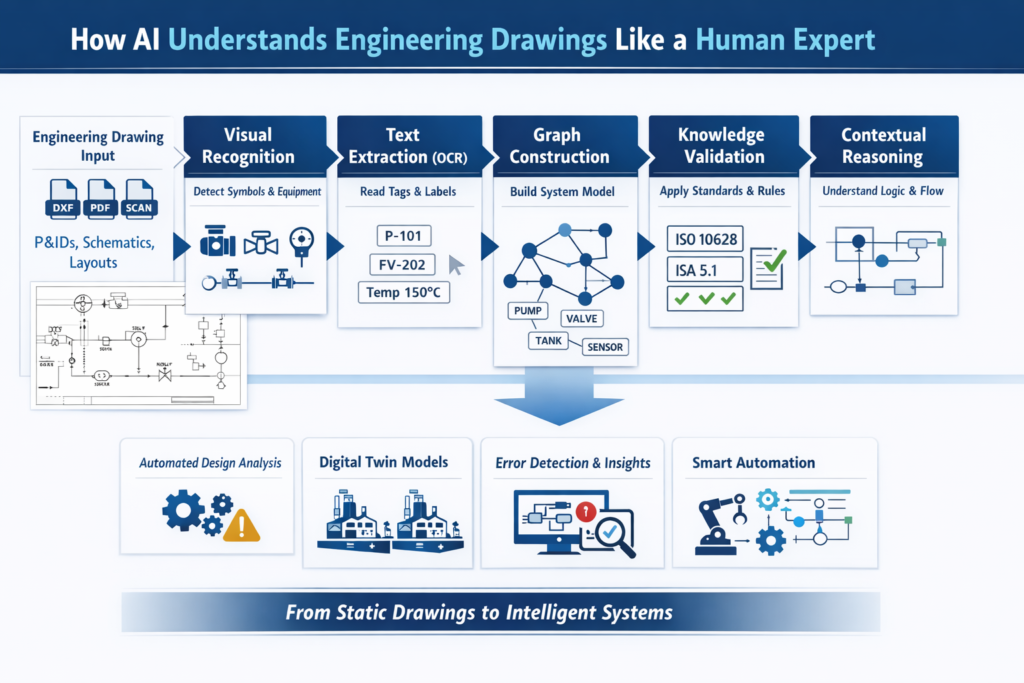
Engineering drawings are the backbone of industrial systems. From P&IDs and electrical schematics to layout diagrams, these documents capture how complex processes are designed, connected, and operated. Yet despite their importance, they remain largely static—requiring manual interpretation by engineers.
Today, Artificial Intelligence (AI) is changing that.
AI is moving beyond simple data analysis into the realm of diagram understanding, enabling machines to interpret engineering drawings in ways that closely resemble human expertise.
Why Understanding Engineering Drawings Matters
Engineering drawings are not just visuals—they are structured representations of systems.
They contain:
- Equipment and components
- Interconnections and flow paths
- Instrumentation and control logic
- Standards-based symbols and annotations
Traditionally, extracting this information requires skilled engineers, making the process:
- Time-consuming
- Error-prone
- Difficult to scale
As industrial systems grow more complex, the need for automated understanding becomes critical.
The Challenge: Why This Is Hard
It’s tempting to assume that reading a drawing is just an image recognition problem. It’s not.
A human engineer doesn’t just “see” a valve—they understand:
- Its function in the system
- Its relationship to upstream and downstream components
- The rules governing how it should behave
AI must replicate this multi-layered reasoning.
Key challenges include:
- Symbol variability across standards and companies
- Unstructured formats (PDFs, scans, DXF files)
- Contextual meaning (a line is not just a line—it represents flow, signal, or control)
- Implicit knowledge embedded in engineering standards
How AI Understands Engineering Drawings
Modern AI systems combine multiple technologies to interpret drawings in a structured and meaningful way.
1. Visual Recognition (Computer Vision)
AI models detect and classify elements within the drawing:
- Equipment (pumps, tanks, compressors)
- Valves and instruments
- Pipelines and connectors
Using computer vision, the system identifies symbols regardless of variations in size, orientation, or format.
2. Text Extraction (OCR)
Drawings contain critical textual data such as:
- Tag numbers
- Line IDs
- Instrument labels
Optical Character Recognition (OCR) extracts this information and links it to detected components.
3. Graph Construction (System Mapping)
Once elements are identified, AI converts the drawing into a graph structure:
- Nodes → Equipment and instruments
- Edges → Connections and flow paths
This step is crucial. It transforms a static drawing into a machine-readable system model.
4. Knowledge-Based Validation
Here’s where AI starts behaving like a human expert.
The system validates extracted data against:
- Engineering standards (e.g., ISO 10628, ISA-5.1)
- Predefined rules and constraints
- Historical design patterns
If inconsistencies are found, the system can:
- Flag errors
- Suggest corrections
- Learn new patterns with expert input
5. Contextual Reasoning
Beyond structure, advanced AI systems understand intent and logic:
- Identifying control loops
- Recognizing process sequences
- Understanding functional relationships
This enables AI to move from “reading drawings” to interpreting systems.
What This Unlocks
Once AI can understand engineering drawings, entirely new capabilities emerge:
Automated Design Analysis
AI can detect inconsistencies, missing components, and non-compliant designs before implementation.
Faster Engineering Workflows
Reduce manual effort in reviewing, updating, and validating drawings.
Digital Twin Enablement
Convert static diagrams into dynamic models that can be simulated and optimized.
Intelligent Automation
Enable systems that can modify, optimize, or even generate designs based on requirements.
Knowledge Preservation
Capture engineering expertise in a reusable, scalable format.
Key Benefits of AI-Based Drawing Understanding
- Speed: Process complex drawings in seconds instead of hours
- Accuracy: Reduce human errors in interpretation and validation
- Scalability: Handle thousands of drawings consistently
- Standardization: Enforce compliance with industry standards
- Operational Insight: Turn static documentation into actionable intelligence
How SMHcoders Can Help
At SMHcoders, we specialize in building AI-driven industrial intelligence systems that bridge the gap between engineering data and operational decision-making.
Here’s how we support organizations:
AI-Powered Drawing Intelligence
Transform P&IDs, schematics, and layouts into structured, machine-readable models.
Custom Computer Vision Models
Detect and classify engineering symbols across multiple standards and formats.
Graph-Based System Modeling
Convert drawings into interconnected system graphs for deeper analysis.
Standards-Driven Validation Engines
Ensure compliance with ISO, ISA, and client-specific rules.
Integration with Industrial Systems
Connect AI outputs with SCADA, IoT platforms, and enterprise systems for real-time insights.
End-to-End Automation Solutions
From document ingestion to intelligent analysis and decision support.
By combining domain expertise with advanced AI technologies, SMHcoders enables organizations to move from static documentation to intelligent, adaptive systems.
Final Thoughts
Engineering drawings have long been a source of truth—but only for those who can interpret them.
AI changes that.
By enabling machines to understand diagrams like human experts, industries can unlock faster workflows, smarter decisions, and a new level of operational intelligence.
The future of industrial systems isn’t just automated—it’s understood.
