
Artificial Intelligence is rapidly transforming industrial operations. From predictive maintenance and energy optimization to digital twins and automated quality control, AI promises smarter decisions and more efficient plants.
Yet many industrial AI initiatives fail after the pilot stage. Models may work perfectly in a laboratory environment but struggle when deployed in real production systems. The reason is rarely the algorithm itself. The real challenge lies in building an end-to-end architecture that integrates data, intelligence, workflows and human expertise into a reliable system.
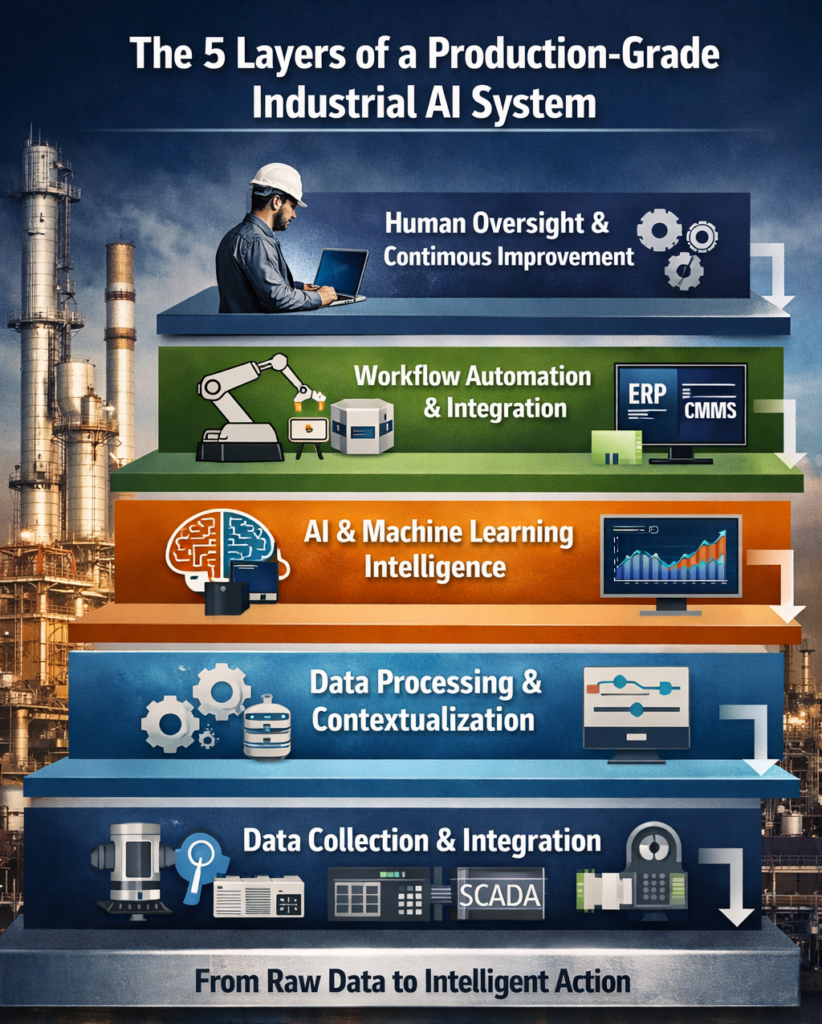
Successful industrial AI platforms are built on multiple interconnected layers that ensure accuracy, scalability and operational reliability. Understanding these layers helps organizations move beyond experimental AI projects and toward production-grade systems that deliver measurable value.
Layer 1: Data Collection and Integration
Every industrial AI system begins with data. Modern facilities generate massive amounts of information from sensors, SCADA systems, PLCs, historians and IoT devices. However, raw industrial data is often fragmented across multiple systems and formats.
A production-grade AI platform must first establish a reliable data pipeline that collects and integrates information from various sources such as equipment sensors, maintenance records, environmental monitoring systems and operational databases.
This layer focuses on:
Aggregating real-time and historical data
Integrating legacy industrial systems with modern platforms
Cleaning and validating incoming data streams
Standardizing formats for analysis
Without a robust data foundation, even the most advanced AI models will produce unreliable results.
Layer 2: Data Processing and Contextualization
Once data is collected, it must be processed and enriched with operational context. Industrial environments require more than raw measurements; they require understanding of equipment behavior, operating conditions and engineering constraints.
In this layer, data is transformed into meaningful insights through preprocessing techniques such as filtering, normalization and anomaly detection. Contextual information, including asset metadata, maintenance history and process parameters, is integrated to create a complete picture of the system.
Key functions of this layer include:
Data cleansing and validation
Feature engineering and transformation
Contextualizing sensor data with operational metadata
Preparing datasets for machine learning models
By converting raw signals into structured, meaningful information, this layer ensures AI models receive accurate and relevant input.
Layer 3: AI and Machine Learning Intelligence
This is the layer most people associate with artificial intelligence. Here, machine learning algorithms analyze processed data to detect patterns, predict failures or optimize operations.
Examples of AI applications in industrial environments include:
Predictive maintenance for rotating equipment
Energy optimization in manufacturing processes
Quality defect detection using computer vision
Demand forecasting for power and utilities
Process optimization through reinforcement learning
The goal of this layer is not simply to build models but to create continuously learning systems that improve over time as more data becomes available.
However, intelligence alone does not create operational impact. The next layer determines whether AI insights actually influence real-world decisions.
Layer 4: Workflow Automation and Operational Integration
Many AI projects fail because insights remain isolated within dashboards or analytical reports. For AI to deliver real value, it must integrate directly into operational workflows.
This layer connects AI outputs with existing enterprise systems such as maintenance management platforms, enterprise resource planning systems and control environments.
For example:
A predictive maintenance model can automatically generate a maintenance work order when a failure risk is detected.
Energy optimization algorithms can adjust process parameters in real time.
Quality inspection systems can trigger alerts or stop production when defects exceed thresholds.
Workflow automation ensures that AI insights move from analysis to action, enabling organizations to respond faster and operate more efficiently.
Layer 5: Human Oversight and Continuous Improvement
Despite advances in automation, industrial operations still rely heavily on human expertise. Engineers, operators and analysts play a critical role in validating AI recommendations and improving system performance.
This final layer introduces human-in-the-loop decision-making, where experts supervise AI outputs and provide feedback to refine models.
Important elements include:
Expert review of AI predictions
Feedback loops for model improvement
Performance monitoring and system governance
Safety and compliance validation
By combining human knowledge with machine intelligence, organizations ensure that AI systems remain reliable, transparent and aligned with operational goals.
Why Layered Architecture Matters
Industrial systems are complex environments where reliability and safety are critical. A layered AI architecture ensures that every stage of the system, from data acquisition to operational decision-making, functions seamlessly.
Organizations that adopt this approach benefit from:
- Higher accuracy and reliability in AI predictions
- Faster deployment and scalability of AI solutions
- Better integration with existing industrial systems
- Greater trust among engineers and operators
Ultimately, production-grade AI systems succeed because they address the entire operational ecosystem, not just the algorithm.
How SMHcoders Can Help
At SMHcoders, we specialize in designing and developing industrial-grade AI systems that integrate seamlessly with real-world operations. Our expertise spans data engineering, machine learning, automation platforms and digital infrastructure.
Here’s how we support organizations in building reliable AI solutions:
Industrial Data Integration
We connect sensors, SCADA systems, IoT devices and enterprise platforms to create unified data pipelines for analytics and AI.
AI and Machine Learning Development
Our team develops predictive models for maintenance, optimization and operational intelligence tailored to industrial environments.
Workflow Automation Platforms
We design systems that integrate AI insights directly into operational workflows, ensuring faster decision-making and measurable efficiency gains.
Digital Twin and Monitoring Solutions
Our platforms provide real-time visualization, asset monitoring and performance tracking for industrial facilities.
Scalable Cloud and Edge Architectures
We deploy secure cloud and edge computing infrastructures that enable scalable AI processing for large industrial datasets.
Final Thoughts
Artificial Intelligence has enormous potential to transform industrial operations, but success requires more than advanced algorithms. Reliable AI systems depend on a structured architecture that connects data, intelligence, automation and human expertise.
Organizations that adopt a layered approach to industrial AI can move beyond experimental pilots and build systems that deliver real operational impact.
At SMHcoders, we help companies turn this vision into reality by designing intelligent platforms that enhance efficiency, improve reliability and unlock the full potential of industrial data.
